
Flexible solar for sunny small spaces.
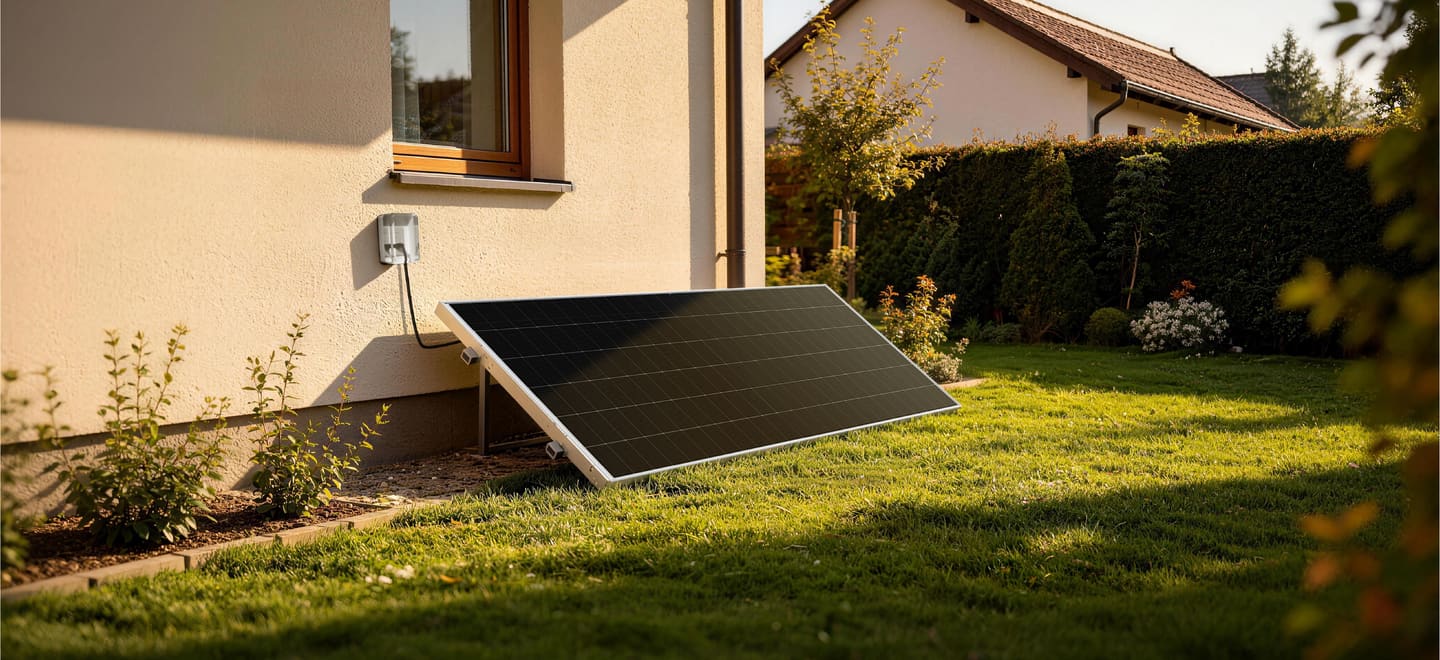
A balcony, patio, fence line, deck, or small ground stand can become a solar location when roof work is not practical.
PLUG-IN SOLAR BASICS
Plug-in balcony solar connects a solar panel to a plug-in microinverter, then sends AC power through a properly rated outdoor outlet where local rules allow it. Daytime loads can use solar first, reducing electricity drawn from the grid.
WHY IT HELPS
A balcony, patio, fence line, deck, or small ground stand can become a solar location when roof work is not practical.

Actual payback depends on your utility rate, sun exposure, self-consumption, system cost, and local requirements.

Start with a focused plug-in setup, learn your production pattern, then decide whether a larger solar system makes sense.
VISUAL PRODUCT GUIDE
This overview image summarizes the key HiFlow Pro features buyers care about: UL3700 plug-in PV safety, plug-and-play outlet connection, smart monitoring, compact size, NEMA Type 6 enclosure, warranty, lifespan, and estimated payback.

FOCUSED PRODUCT PAIRING
Compare two Hoymiles HiFlow 120V plug-in microinverters and two individual solar panel options from 410W to 445W before checking mounting, cable, outlet, and local approval requirements.
The HiFlow plug-in microinverter converts module DC power into AC power for a properly rated outlet-connected PV setup where local rules allow it. Compare the 360W and 391W models in this collection.
Compare ZNShine 410W and Talesun 445W modules sold by piece for compact balcony, patio, deck, fence, or small ground-area projects.
This page lists 4 products: 2 HiFlow 120V plug-in microinverters and 2 individual 410W–445W solar panels. Review each product page for current price, inventory, specifications, compatibility, and required accessories.
HOW PLUG-IN SOLAR WORKS
Plug-in balcony solar is easiest to understand when the power path is shown in order: solar module, microinverter, outlet, home loads, and utility grid rules.
Position and secure the solar module where it receives strong sun while following building, wind, landlord, HOA, and local mounting requirements.
The HiFlow microinverter converts solar DC output into AC power for a compatible plug-in PV power path.
When the panel is producing, nearby home loads can use that solar energy first, reducing the amount drawn from the utility grid.
Production can exceed instant home demand. Check local utility interconnection and export requirements before operating a plug-in PV system.
BEST-FIT APPLICATIONS
This is a small-space solar category for users who want to offset daytime loads without starting with a full rooftop system.
BEFORE YOU ORDER
Use this checklist to avoid the common mistakes with plug-in PV projects.
U.S. LEGISLATION TRACKER
As of October 3, 2026, 10 states have signed plug-in solar legislation, 1 bill is awaiting governor action, 3 remain active, 21 were deferred, and 16 states have no dedicated bill listed. The maximum AC output column shows a legal wattage cap only for signed laws; pending legislation is not permission to operate. A signed law may also have a future effective date, so always check the date and local requirements before installation.
| Status | State / Jurisdiction | Bill | Max AC output | Effective date / next step | Latest status |
|---|---|---|---|---|---|
| Signed into law | California | SB 868 | 1,200 W | Jan 1, 2027 | Signed Sep 30, 2026; qualifying systems remain subject to the law's safety and implementation requirements. |
| Signed into law | Colorado | HB 26-1007 | 1,920 W | Aug 12, 2026 | Signed May 7, 2026; qualifying systems may be rated up to 1,920 W. |
| Signed into law | Connecticut | HB 5340 / Public Act 26-127 | 1,200 W | Oct 1, 2026 | Signed Jun 4, 2026; establishes a state pathway for qualifying plug-in solar devices. |
| Signed into law | Maine | LD 1730 | 1,200 W | Jul 15, 2026 | Signed Apr 6, 2026; complete-system certification requirements still apply. |
| Signed into law | Maryland | HB 1532 | 1,200 W | Jul 1, 2026 | Signed May 12, 2026; the law includes separate treatment for systems at or below 391 W. |
| Signed into law | New Hampshire | SB 540 | 1,200 W | Jan 1, 2027 | Signed Jul 2, 2026; the plug-in solar framework takes effect in 2027. |
| Signed into law | New Jersey | S 2368 / A 4836 | 1,200 W | Mar 1, 2027 | Garden State Balcony Solar Act; signed Sep 1, 2026. |
| Signed into law | Utah | HB 340 | 1,200 W | May 7, 2025 | Signed Mar 25, 2025; the first state plug-in solar law in the U.S. |
| Signed into law | Vermont | S 202 | 1,200 W | Jul 1, 2026 | Signed Jun 16, 2026; complete-system certification requirements still apply. |
| Signed into law | Virginia | HB 395 | 1,200 W | Jan 1, 2027 | Signed Apr 22, 2026; the state framework begins in 2027. |
| Awaiting governor | New York | S 8512A / A 9111C | 1,200 W proposed | Pending signature | The SUNNY Act passed both chambers May 28, 2026 and is not yet signed into law. |
| Active bill | Massachusetts | H 5175 | Pending bill | Bill in progress | Portable solar provisions remain part of legislation under consideration. |
| Active bill | Pennsylvania | HB 1971 | Pending bill | Bill in progress | Referred to the House Energy Committee; no enactment date yet. |
| Active bill | Washington, DC | B26-0602 | Pending bill | Bill in progress | District legislation remains under consideration. |
| Deferred to 2027 | Alaska | HB 257 | Pending bill | 2027 session | Expected to be reconsidered or reintroduced in 2027. |
| Deferred to 2027 | Arizona | SB 1606 | Pending bill | 2027 session | Expected to be reconsidered or reintroduced in 2027. |
| Deferred to 2027 | Delaware | SB 270 | Pending bill | 2027 session | Expected to be reconsidered or reintroduced in 2027. |
| Deferred to 2027 | Georgia | HB 1304 | Pending bill | 2027 session | Expected to be reconsidered or reintroduced in 2027. |
| Deferred to 2027 | Hawaii | SB 2902 | Pending bill | 2027 session | Expected to be reconsidered or reintroduced in 2027. |
| Deferred to 2027 | Idaho | HB 612 | Pending bill | 2027 session | Expected to be reconsidered or reintroduced in 2027. |
| Deferred to 2027 | Illinois | SB 3104 | Pending bill | 2027 session | Expected to be reconsidered or reintroduced in 2027. |
| Deferred to 2027 | Indiana | SB 74 / HB 1084 | Pending bill | 2027 session | Expected to be reconsidered or reintroduced in 2027. |
| Deferred to 2027 | Iowa | HF 2046 | Pending bill | 2027 session | Expected to be reconsidered or reintroduced in 2027. |
| Deferred to 2027 | Michigan | HB 5764 | Pending bill | 2027 session | Expected to be reconsidered or reintroduced in 2027. |
| Deferred to 2027 | Minnesota | SF 4504 | Pending bill | 2027 session | Expected to be reconsidered or reintroduced in 2027. |
| Deferred to 2027 | Missouri | HB 2528 / HB 2444 | Pending bill | 2027 session | Expected to be reconsidered or reintroduced in 2027. |
| Deferred to 2027 | New Mexico | SB 157 | Pending bill | 2027 session | Expected to be reconsidered or reintroduced in 2027. |
| Deferred to 2027 | North Carolina | HB 1129 / SB 957 | Pending bill | 2027 session | Expected to be reconsidered or reintroduced in 2027. |
| Deferred to 2027 | Ohio | HB 755 | Pending bill | 2027 session | Expected to be reconsidered or reintroduced in 2027. |
| Deferred to 2027 | Oklahoma | HB 4060 | Pending bill | 2027 session | Expected to be reconsidered or reintroduced in 2027. |
| Deferred to 2027 | Oregon | HB 4080 | Pending bill | 2027 session | Expected to be reconsidered or reintroduced in 2027. |
| Deferred to 2027 | Rhode Island | HB 7269 | Pending bill | 2027 session | Expected to be reconsidered or reintroduced in 2027. |
| Deferred to 2027 | South Carolina | HB 4579 | Pending bill | 2027 session | Expected to be reconsidered or reintroduced in 2027. |
| Deferred to 2027 | Washington | SB 6050 | Pending bill | 2027 session | Expected to be reconsidered or reintroduced in 2027. |
| Deferred to 2027 | Wyoming | HB 146 | Pending bill | 2027 session | Expected to be reconsidered or reintroduced in 2027. |
| No bill introduced | Alabama | N/A | N/A | No dedicated state bill | No plug-in solar legislation listed in the current tracker. |
| No bill introduced | Arkansas | N/A | N/A | No dedicated state bill | No plug-in solar legislation listed in the current tracker. |
| No bill introduced | Florida | N/A | N/A | No dedicated state bill | No plug-in solar legislation listed in the current tracker. |
| No bill introduced | Kansas | N/A | N/A | No dedicated state bill | No plug-in solar legislation listed in the current tracker. |
| No bill introduced | Kentucky | N/A | N/A | No dedicated state bill | No plug-in solar legislation listed in the current tracker. |
| No bill introduced | Louisiana | N/A | N/A | No dedicated state bill | No plug-in solar legislation listed in the current tracker. |
| No bill introduced | Mississippi | N/A | N/A | No dedicated state bill | No plug-in solar legislation listed in the current tracker. |
| No bill introduced | Montana | N/A | N/A | No dedicated state bill | No plug-in solar legislation listed in the current tracker. |
| No bill introduced | Nebraska | N/A | N/A | No dedicated state bill | No plug-in solar legislation listed in the current tracker. |
| No bill introduced | Nevada | N/A | N/A | No dedicated state bill | No plug-in solar legislation listed in the current tracker. |
| No bill introduced | North Dakota | N/A | N/A | No dedicated state bill | No plug-in solar legislation listed in the current tracker. |
| No bill introduced | South Dakota | N/A | N/A | No dedicated state bill | No plug-in solar legislation listed in the current tracker. |
| No bill introduced | Tennessee | N/A | N/A | No dedicated state bill | No plug-in solar legislation listed in the current tracker. |
| No bill introduced | Texas | N/A | N/A | No dedicated state bill | No plug-in solar legislation listed in the current tracker. |
| No bill introduced | West Virginia | N/A | N/A | No dedicated state bill | No plug-in solar legislation listed in the current tracker. |
| No bill introduced | Wisconsin | N/A | N/A | No dedicated state bill | No plug-in solar legislation listed in the current tracker. |
This legislation tracker is informational, not legal advice. "Signed" does not always mean "currently effective," and states without a dedicated bill may still require utility interconnection, permits, product certification, or other approvals. Rules can also vary by utility, AHJ, landlord, HOA, outlet and circuit configuration, and export behavior. Confirm current state, utility, and local requirements before purchasing, installing, or operating a system.
PLUG-IN SOLAR FAQ
Plug-in solar rules are changing state by state. Some states have clear plug-in solar legislation or simplified registration rules, while other areas may still require utility interconnection approval, permits, or AHJ review. Before operating a system, confirm the current state rule, utility requirement, outlet requirement, landlord or HOA rule, and local electrical code.
Choose a 120V microinverter that is specifically designed and listed for plug-in PV use, not just a standard rooftop solar microinverter. For U.S. plug-in applications, important signals include UL 3700 for plug-in PV safety, UL 1741 or UL 1741 SB for grid-interactive inverter compliance, IEEE 1547 compatibility, anti-islanding, GFCI compatibility, and manufacturer instructions for direct outlet connection. In this collection, confirm the exact Hoymiles HiFlow model, AC output rating, module input range, and required accessories before ordering.
It depends on the system rating, outlet type, branch circuit load, product instructions, and local code. A properly rated outdoor GFCI outlet is typically required, and some plug-in PV rules or product instructions may call for a dedicated circuit to reduce overload or breaker-masking risk. Have the circuit rating and existing loads checked before installation, especially if the outlet will be used near the system's maximum output.
The panel placement and basic product setup may be DIY-friendly where local rules allow it. Electrical work is different: adding or modifying a receptacle, breaker, GFCI protection, dedicated circuit, service equipment, or monitoring hardware may require a licensed electrician and inspection. Follow the manufacturer's instructions and confirm AHJ and utility requirements before energizing the system.
Utility approval depends on your state, utility, system size, and export behavior. Some plug-in solar laws create a simplified path for small systems, while other locations still require an interconnection application before operation. If the system can export power, assume the utility rules matter and check them before plugging in.
Use a compatible zero-export control setup with a real-time energy meter or current transformer so the microinverter can reduce output when home demand is low. You can also size the system around daytime base loads, but load matching alone is not a guaranteed zero-export method. Zero export depends on compatible hardware, correct meter placement, app configuration, and site conditions.
A Hoymiles HiFlow or HiFlow Pro based setup can support zero-export control when paired with a compatible energy meter and configured correctly in the monitoring app. Make sure the kit you buy includes or supports the required meter, communication path, and firmware features; a panel plus microinverter alone should not be assumed to provide zero export.
A basic plug-in solar setup offsets daytime loads only. To use solar power at night, you need a compatible battery architecture that is designed for charging, storage, and controlled discharge. Do not plug a grid-tied microinverter into a battery or portable power station unless the battery manufacturer explicitly supports that connection method.
Only if the battery system explicitly supports the connection you plan to use. Many EcoFlow and Anker power stations accept DC solar input within strict voltage and current limits, while a plug-in microinverter outputs 120V AC and is usually intended for a grid-connected receptacle. Tesla Powerwall is a professionally installed home battery system, not a plug-in balcony device. Confirm compatibility from the battery manufacturer before connecting anything.
Estimate savings with this formula: annual solar production multiplied by the percentage used on site multiplied by your retail electricity rate. A 1.2kW system might produce roughly 1,300 to 1,900 kWh per year depending on sun, tilt, direction, shading, and climate. If 70% to 90% is consumed on site at $0.25 to $0.40 per kWh, annual bill savings could land around $230 to $680. Savings are lower if production is shaded, exported without credit, or limited by zero-export control.


