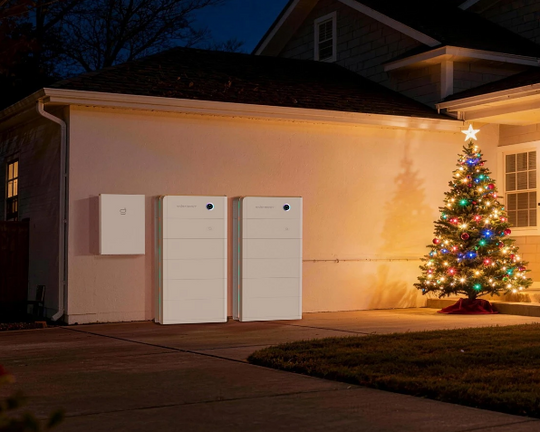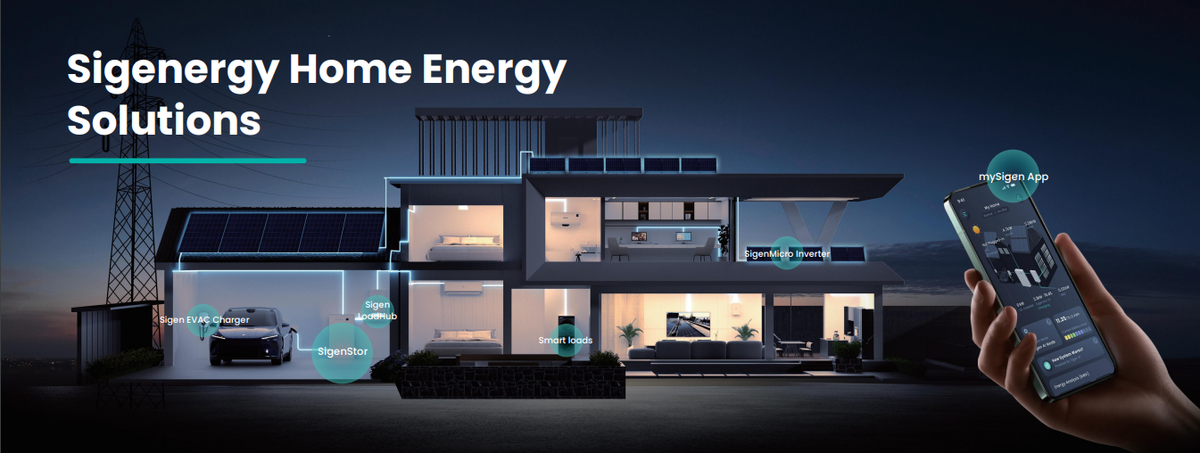
The Sigenergy system has six components. Only three are required for every setup: the SigenStor battery, the Sigen Energy Controller, and the LoadHub. Everything else — the EVDC V2X Module, Power Sensor, and 4G module — is optional, added based on your backup coverage, EV ownership, and monitoring needs. For essential-load backup setups, the Power Sensor is also required.
Sigenergy is a modular home energy storage platform, not a standalone battery. The SigenStor battery stores energy — both the BAT 6.0 and BAT 9.0 carry UL9540 and UL1973 certifications for US residential installations. The Energy Controller manages where that energy goes: between solar, your home, and the grid, certified UL1741, UL9540, and CEC Listed.
This guide covers every component: what it does, which buyers need it, and how to build the setup that matches your home.
Browse Sigenergy home energy storage systems
What Each Sigenergy Component Does
Here’s a closer look at each product and the buyer it serves.
SigenStor Batteries: BAT 6.0 and BAT 9.0
SigenStor BAT 6.0 and BAT 9.0 are the core battery modules in the Sigenergy system. Both use LFP (lithium iron phosphate) chemistry and carry UL9540 and UL1973 certifications — key safety and performance standards for US residential energy storage. Both come with a 10-year warranty, guaranteeing at least 90% of usable capacity at year 10.
Compare SigenStor BAT 6.0 and BAT 9.0
When to Choose SigenStor BAT 6.0
The BAT 6.0 provides 6.02 kWh of usable capacity. Under a 3kW essential load draw, that’s roughly 2 hours of backup per module. It’s built for essential-load backup — covering your critical circuits (refrigerator, lighting, medical equipment, router) during an outage without oversizing the system. It’s also a good starting point for buyers building a modular Sigenergy setup over time. Per battery sizing guidance from the U.S. Department of Energy, the right system is built around your actual backup load, not a worst-case figure.
Backup time estimates are based on a 3kW draw scenario. Actual backup time depends on your home’s specific load. Confirm sizing with your installer.
When to Choose SigenStor BAT 9.0
The BAT 9.0 provides 9.04 kWh of capacity. Under a 3kW essential load draw, that’s roughly 3 hours of backup per module. Two BAT 9.0 units give you 18.08 kWh — approximately 6 hours under the same load. It’s built for larger home battery backup: longer outage protection and higher electricity usage. Buyers who want more backup capacity, or plan to add EV charging later, should start here. The system scales from a single BAT 6.0 all the way up to 54.24 kWh in a single setup.
Backup time estimates are based on a 3kW draw scenario. Actual backup time depends on your home’s specific load. Confirm sizing with your installer.
Sigen Energy Controller: The Control Center of the System
The Sigen Energy Controller manages energy flow between solar, battery, home loads, and the grid. It delivers 11.5kW of continuous output power and supports up to 23kW of PV input — certified UL1741, UL9540, and CEC Listed for US residential installations. It’s a required component in every Sigenergy setup. Not an add-on. It carries a 10-year warranty.
Without the controller, the other products don’t function as a system. It handles grid interaction, solar optimization, and battery charging logic.
View the Sigen Energy Controller
Sigen LoadHub: Backup Load Management for Your Home
The Sigen LoadHub supports backup load management, power distribution, and whole-home backup planning. It extends what the Energy Controller does at the load level. Rated for split-phase 120/240V at 200A.
When You Need the Sigen LoadHub
The simple rule: if you want to protect circuits beyond a basic essential-load panel, LoadHub is the component that makes that possible.
Use LoadHub when:
- You want whole-home backup across your full 200A panel (not just a critical-loads sub-panel)
- You need to manage which circuits get power during an outage — and when
- You want automatic load switching without manual intervention
- You’re planning a larger battery setup (multiple modules) and need distribution to match
If you’re protecting only a handful of essential circuits through a dedicated sub-panel, the Energy Controller alone can handle it. Once you move beyond that — more circuits, whole-home coverage, or flexible load management — LoadHub is the right addition.
Exact panel configuration requirements vary by installation. Confirm with your installer whether LoadHub is needed for your specific setup.
Sigen EVDC V2X Module: EV Charging and V2X Integration
The Sigen EVDC V2X Module is a bidirectional DC charger rated at 25kW. It supports standard EV charging, vehicle-to-home (V2H), vehicle-to-grid (V2G), and solar EV charging — using your panels to charge your vehicle directly through the Sigenergy system.
Buyers who own an EV and want to integrate solar charging, battery storage, V2H (vehicle-to-home), V2G (vehicle-to-grid), or broader V2X (vehicle-to-everything) capabilities will find this module ties it all together. According to the American Solar Energy Society, roughly one in four EV owners also own solar — a natural pairing for households looking to reduce energy costs and gain greater independence.
It’s available in two connector versions:
- CCS1 (Model 11080031) — compatible with most non-Tesla EVs, including Ford, Rivian, GM, Hyundai/Kia, BMW, and VW
- NACS (Model 11080032) — compatible with Tesla and NACS-enabled EVs
It also enables solar EV charging — using your panels to charge your vehicle directly through the Sigenergy system. Select the version that matches your vehicle’s DC charging port. If you don’t own an EV, this product isn’t required for your setup.
View the Sigen EVDC V2X Module
Sigen Power Sensor: Monitoring Energy Usage
The Sigen Power Sensor measures energy flow across your home using external CT (current transformer) clamps and provides real-time data through the Sigenergy app. It monitors voltage, current, power, and frequency per phase. It’s available in single-phase (100A CT) and three-phase (120A CT) versions to match your home’s electrical configuration.
For essential-load backup setups, the Power Sensor is a required component. For all other setups, it’s an optional accessory for homeowners who want to track solar production, monitor consumption, and reduce utility bills over time. Warranty: 2 years.
View the Sigenergy Power Sensor
Sigenergy 4G Communication Module: Connectivity and Remote Monitoring
The Sigenergy 4G module supports remote energy monitoring and connectivity — especially when Wi-Fi is weak, unreliable, or unavailable. It’s plug-and-play compatible with the Sigen Energy Controller and comes with a 2-year or 5-year cellular service plan. It’s a practical addition for rural installs or properties where the inverter location has poor wireless coverage. Warranty: 2 years.
Sigenergy Mounting Accessories and Installation Hardware
Sigenergy mounting accessories and installation hardware support a proper physical setup. The base wall-mount bracket secures the system to a wall for space-efficient installation. Buyers should confirm installation requirements with their installer before ordering.
Required vs. Optional: Sigenergy System Components
Not every component is mandatory. Here’s which products each buyer goal requires, and what’s worth adding.
|
Buyer Goal |
Required |
Recommended Optional |
|
Essential-load backup (small home / critical circuits only) |
SigenStor BAT 6.0 + Energy Controller + LoadHub + Power Sensor |
4G Module (if no Wi-Fi) |
|
Whole-home backup |
SigenStor BAT 9.0 + Energy Controller + LoadHub |
Power Sensor, 4G Module (if no Wi-Fi) |
|
Solar storage + backup (medium home) |
SigenStor BAT 9.0 + Energy Controller + LoadHub |
Power Sensor, 4G Module (if no Wi-Fi) |
|
EV integration + home backup |
SigenStor BAT 9.0 + Energy Controller + LoadHub + EVDC V2X Module |
Power Sensor |
|
Expanded capacity / future-proof |
Multiple BAT 9.0 modules or BAT 6.0 + Energy Controller + LoadHub |
EVDC V2X Module (if EV owned) |
|
Existing solar system retrofit |
Sigen Energy Controller + BAT 9.0 or BAT 6.0 + LoadHub |
Power Sensor, 4G Module (if no Wi-Fi), EVDC V2X |
The components in the “Recommended Optional” column are never required for the system to operate. They add capability — monitoring, load management, or EV integration — based on your specific goals.
How to Choose Your Sigenergy Configuration
The main buying factors are:
- Backup goal — essential loads only, or whole-home coverage?
- Battery capacity — how many kWh do you need?
- Existing solar retrofit — are you pairing this with new or existing solar?
- EV ownership — do you need V2H, V2G, or solar EV charging?
- Monitoring needs — do you want remote access or usage data?
- Installation environment — does your site have reliable Wi-Fi, or do you need the 4G module?
Future expansion — are you planning to add capacity later?
Start with your backup goal. That determines which battery size you need, whether LoadHub is required, and which accessories to add. Everything else layers on from there.
Sigenergy Setups by Use Case
Whether you need a basic essential-load setup or whole-home coverage, the table below maps common use cases to the right product combination. All system bundles ship free from Self2Solar.
|
Use Case |
Components |
Total Capacity |
|
Essential backup — small home (1–2 critical circuits) |
BAT 6.0 + Energy Controller + LoadHub + Power Sensor |
6.02 kWh |
|
Essential backup — medium home (3–5 critical circuits) |
BAT 9.0 + Energy Controller + LoadHub + Power Sensor |
9.04 kWh |
|
Whole-home backup — medium home |
BAT 9.0 x2 + Energy Controller + LoadHub |
18.08 kWh |
|
Whole-home backup — large home |
BAT 9.0 x4 + Energy Controller + LoadHub |
36.16 kWh |
|
EV owner + home backup |
BAT 9.0 + Energy Controller + LoadHub + EVDC V2X Module |
9.04 kWh + EV charging |
|
Maximum capacity (single system) |
BAT 9.0 x6 + Energy Controller + LoadHub |
54.24 kWh |
Common Mistakes to Avoid When Buying Sigenergy Products
The most expensive mistake is sizing the battery to your budget instead of your backup load. A BAT 6.0 covering a 30-amp essential panel will run for roughly 2 hours under a 3kW draw. If your backup goal is overnight outage protection, that’s not enough. Size first, price second.
Here are the other common mistakes buyers make:
- Choosing capacity by price only — size your battery to your actual backup load, not the lowest price point. The U.S. Department of Energy notes that solar-plus-storage systems deliver reliable power only when sized to your home’s actual energy needs.
- Ignoring backup loads — list the circuits you need covered before choosing BAT 6.0 vs BAT 9.0
- Forgetting EV needs — if you own an EV, factor in the EVDC V2X Module from the start
- Skipping compatibility checks — always confirm that the Sigenergy system is compatible with your inverter and home electrical configuration before ordering
- Overlooking certifications — for US installations, look for UL9540, UL1973, and UL1741. SigenStor batteries carry UL9540 and UL1973; the Energy Controller carries UL1741 and UL9540
- Not planning for expansion — if you may add capacity later, choose a setup that scales (the system supports up to 54.24 kWh)
Where to Buy Sigenergy Products Online
Self2Solar carries the full Sigenergy product line — whether you want to buy a SigenStor battery, a full system bundle, or individual accessories like the 4G module and Power Sensor. Free shipping applies on all system bundles. Browse with confidence — compatibility details, sizing guidance, and shipping support are available.
FAQs About Buying Sigenergy Products
Sigenergy System FAQs
What is Sigenergy?
Sigenergy is a modular home energy storage system. It combines LFP batteries, a controller, and optional accessories into a connected platform for backup power, solar storage, and energy management.
How does the system work?
The Energy Controller manages energy flow between solar panels, the battery, your home loads, and the grid. The battery stores energy. The other components — EVDC V2X Module, Power Sensor — add specific capabilities depending on your setup.
Which components are commonly used together?
At minimum: a SigenStor battery, the Energy Controller, and the LoadHub. Essential-load backup setups also require the Power Sensor. EV owners add the EVDC V2X Module.
Understand Sigenergy system components
SigenStor Battery FAQs
What’s the difference between BAT 6.0 and BAT 9.0?
The BAT 6.0 offers 6.02 kWh of capacity. The BAT 9.0 offers 9.04 kWh. The BAT 9.0 suits larger homes, higher usage, and longer outage coverage. The BAT 6.0 is the right starting point for smaller homes or essential-load backup. Both use LFP (lithium iron phosphate) chemistry, carry UL9540 and UL1973 certifications, and come with a 10-year warranty (90% capacity retention at year 10).
Can I add more batteries later?
Yes — the Sigenergy system is modular. It scales from a single BAT 6.0 up to 54.24 kWh in one system.
What’s the battery warranty?
Both the BAT 6.0 and BAT 9.0 carry a 10-year warranty. Sigenergy guarantees the battery retains at least 90% of its usable capacity at year 10, or a minimum throughput energy (18.58 MWh for BAT 6.0; 27.86 MWh for BAT 9.0), whichever comes first.
What’s the battery count and backup time?
Backup time depends on your load size and how many batteries you install. Work through your essential circuits to estimate your power draw before choosing your setup.
Compare SigenStor battery modules
Sigen Energy Controller FAQs
Do I need the Energy Controller?
Yes. It’s required for every Sigenergy setup. It’s what makes the battery and other components function as a system.
What does the controller do?
It manages energy flow between solar, battery, home loads, and the grid. It delivers 11.5kW of continuous output power, handles up to 23kW of PV input, and is certified UL1741, UL9540, and CEC Listed.
What’s the warranty on the Energy Controller?
The Sigen Energy Controller carries a 10-year warranty.
How does it work with the LoadHub?
The Energy Controller handles system-level management. The LoadHub extends control to individual loads — useful for whole-home backup and advanced circuit planning.
View the Sigen Energy Controller
Sigen LoadHub FAQs
What does LoadHub do?
It manages backup load distribution across your home. It supports whole-home backup, essential load backup, and advanced backup power planning. It’s rated for split-phase 120/240V at 200A.
Do I need LoadHub for essential-load backup?
Yes. LoadHub is a required component in every Sigenergy setup. It works alongside the Energy Controller to manage backup loads across your circuits.
Sigen EVDC V2X Module FAQs
What is the Sigen EVDC V2X Module?
It’s a bidirectional DC charger rated at 25kW, designed to work within the Sigenergy ecosystem. It supports standard EV charging, V2X, V2H, V2G, and solar EV charging. It’s available in CCS1 (most non-Tesla EVs) and NACS (Tesla and NACS-compatible EVs) versions.
Which connector version do I need?
If your EV charges via CCS1 (Ford, Rivian, GM, Hyundai/Kia, BMW, VW, and others), choose Model 11080031. If you drive a Tesla or a NACS-compatible EV, choose Model 11080032.
Do I need it if I own an EV?
If you want to integrate EV charging with your solar and battery system — yes. If you just want standard Level 2 AC charging, it’s not required.
View the Sigen EVDC V2X Module
Power Sensor FAQs
What does the Power Sensor do?
It uses external CT clamps to measure energy flow — voltage, current, power, and frequency per phase — and sends that data to the Sigenergy app in real time. It’s available in single-phase (100A CT) and three-phase (120A CT) versions.
When do I need it?
The Power Sensor is required for essential-load backup setups. For all other setups, it’s optional — but recommended for homeowners who want real-time visibility into solar production, consumption tracking, and utility bill reduction.
What’s the warranty?
The Power Sensor carries a 2-year warranty.
View the Sigenergy Power Sensor
4G Communication Module FAQs
What does the 4G module do?
It provides remote connectivity and monitoring when Wi-Fi is unavailable or unreliable. It’s plug-and-play compatible with the Sigen Energy Controller series.
Does it include a data plan?
Yes — it comes with either a 2-year or 5-year cellular service plan.
Is Wi-Fi an alternative?
Yes — if your install location has reliable Wi-Fi, the 4G module is optional.
When is remote monitoring important?
For rural installs, vacation properties, or any location where you want system visibility without being on-site.
What’s the warranty?
The 4G Communication Module carries a 2-year warranty.
Mounting and Accessory FAQs
What mounting kits are available?
Sigenergy offers a base wall-mount bracket for securing the system to a wall. Confirm requirements with your installer before ordering.
Are accessories compatible with all setups?
Check accessory compatibility with your battery count and installation configuration before purchasing.
Compatibility FAQs
Is Sigenergy compatible with my solar panels?
Sigenergy works with most residential solar setups — confirm inverter and panel compatibility with your installer or reach out to Self2Solar for guidance.
Is it compatible with EV charging?
Yes, via the Sigen EVDC V2X Module. The charger is available in CCS1 and NACS versions — confirm your EV’s DC charging connector before ordering.
What about home electrical setup?
Sigenergy is designed for US split-phase (120/240V) residential systems. Confirm your home electrical setup before purchasing.
Can I expand the system?
Yes. The modular design supports adding batteries over time, scaling up to 54.24 kWh in a single system.
Buying and Shipping FAQs
Can I buy Sigenergy products online?
Yes — Self2Solar carries the full Sigenergy line and ships across the US. All system bundles include free shipping.
What about shipping quotes?
Reach out to Self2Solar for shipping quote support on larger orders. Product and bundle availability are listed on the collection page.
How do I select the right products?
Use this guide to narrow your setup based on your backup goal, battery capacity, and EV needs. Browse the full Sigenergy line at Self2Solar, where compatibility details and sizing guidance are available.
Final Recommendation
A complete Sigenergy system may include UL-certified LFP batteries, the Energy Controller, LoadHub, EVDC V2X Module, Power Sensor, 4G Communication Module, and mounting accessories. Every core component carries US certifications: UL9540 and UL1973 on batteries, UL1741 and UL9540 on the Energy Controller. SigenStor batteries and the Energy Controller are backed by a 10-year warranty; the Power Sensor and 4G module carry 2-year coverage.
The right setup depends on your home energy use, backup goals, solar setup, EV ownership, and monitoring needs. Start with your goals — the components follow.